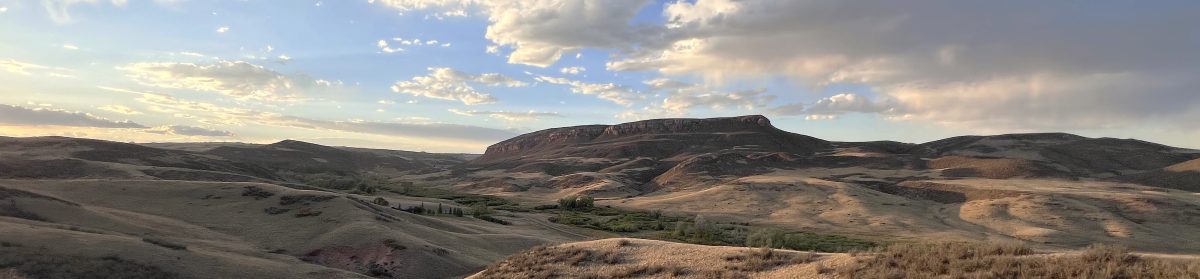
Sometimes you take a random photo and find it interesting, despite having left it raw and unedited. Such was the case with this picture of a rainstorm off to the northeast of our home this week.
The gradient of the sky was a beautiful mix of warm hues as the evening golden hour came to a close over the valley below. The land was holding on to the last light, giving the grass and scrub a coppery look. To me it is a comforting and natural landscape to let the eyes wander in.
Seeing this surprise visit by the local herd seeking refuge from the wind.
Note: I occasionally find drafts of posts I’ve forgotten to publish. I loved the photos from this day, so even though it’s from January this year, which is a far older gap in time than I would normally publish from, am adding it in now. The text remains as I drafted it then.
The few homes that make up our rugged little valley area that we live above are filled with wildlife enthusiasts who love our local mule deer population.
Heading out towards the wind protection of the sage bush and hills.
We are a mix of households in this small community that both hunt and protect the deer, but we all get along for the most part. The animal lovers are not afraid to call out any untoward hunting behaviors from outside the community and the local hunters are generally respectful and follow the law.
The second in command 3×3 keeping an eye on things.
Lately, Wyoming has taken a real thrashing from unseasonably high winds. Don’t get me wrong, it’s ALWAYS windy here – our home averages 40-60mph winds in the winter months (gusts into hurricane force speeds over 90-100mph range). But in recent weeks it’s been very gusty (a top speed nearby of 144mph was recorded in one location).
The second in command (3×3) licking his salty lips after visiting the mineral block.
When it gusts here, the deer head for the protection of the scrub brush and the hills around our home. On their way there, they like to stop by our front yard where we keep mineral blocks and water for them.
A young one trying to stay vertical in the wind – several got pushed around by the gusts.
We like to think of our home as a refuge from the public areas where hunting is permitted. The deer can safely move from the open grasslands we sit on right into the hills our property borders.
The does and yearlings take off first.
Admittedly, it also brings them into viewing range of our home where we can enjoy seeing them. Being an animal lover, I’m not ashamed to admit that I try to name each one for as long as I’m able to distinguish them from each other (which is not a long time).
The first and second in command bucks bring up the rear.
On this particular day, they did not hang around. After quick sips and licks, they were moving on to escape the winds. It was really hard gusts this day and the smallest yearlings had a hard time staying vertical.
A small yearling began to get distracted and fell behind.
Our local herds constantly change throughout the year and seasons. Bucks come and go, and groups or individuals will break off and rejoin different groups as time goes by.
No worries, Mom noticed and ensured her little one caught up.
The fawns are my favorites to watch. Sometimes I get lucky and they have distinguishing features that allow me to keep track of them throughout the year. If not, I lose track of who is who and eventually they all become “the herd” after a year or so.
First in command took the lead and stood at the hill’s base while the rest ventured above him.
The does are so attentive to the fawns. They go to great lengths to keep them alive against coyotes and other predators. These are some hard-working mamas here!
Does and yearlings heading into the wind break of the scrub and brush.
This is the most that have congregated on our property in a long time. We counted nineteen in total for this visit. It’s encouraging to see so many still around now that hunting season finally concluded at the end of December.
The two bucks remained behind until all were well into the hillside.
After they all took turns at the water buckets and the mineral blocks, they followed their usual path. They typically prefer either our two track driveway or the path of prairie dog targets my husband put in as they head for the hills.
A final look, and the first in command followed the herd last up the hillside.
This one really made me laugh a few days ago. We had tossed some uneaten pineapple chunks from our fridge onto the ground below our back deck. Later that evening, I had gone downstairs in our walkout basement for something and on passing by the sliding glass door, encountered this buck enjoying the pieces in the grass. And if he didn’t seem to be grinning with a piece in his mouth when I surprised him while he was mid-chew. What a ham!
Things start moving and inching in Snail Town when the carrots come out. Quick Gloss snails, big and small, all appear when the juicy delicacies are placed around the terarrium.
Recently I spread out a slew of baby carrot slices along with mushrooms and within 15-30 minutes, ALL the inhabitants came out for a community feast. They will munch microscopically for a few hours and then start to disappear back into the moss, earth, and under the stones.
On food days, this little town is the place to be with gatherings around what must be the most tasty morsels.
I have not figured out why they congregate around certain pieces, unless that happens to be where more snails are snoozing just below. Perhaps there is just something more tasty about some slices versus others.
It’s such a fascinating and curious little place, this snailarium. Never the same sightings twice. Each shell is different and unique.
Sometimes they pick up dirt or calcium powder on their shells and it gives them a more matte looking finish.
Often I will see the tiniest of baby snails. Nearly impossible for my aging eyes to see, a powerful camera lens comes in handy to get to appreciate them.
Apparently they are unbothered to gather in groups on a single piece of food. Sliding around and over each other, the feast continues.
It’s a good time to slow down and look carefully in the smallest of places – I never fail to spot some resting or hiding away. This tiny snail with glass-like whorls found a good hammock in some dried out moss.
The final remaining bloom of this small and magical phalaenopsis
A small, hardy phalaenopsis held on to her last bloom for several weeks this year. I have started to capture what is blooming in my home going forward to help me record each plant for when they enter dormancy later. Some of my orchids were obtained without any identification, so for most like this I have had to issue them names that can help me remember which ones they are until I can identify them officially.
This gal got placed in one of my favorite pots due to her coloration
This gal got placed in one of my favorite pots due to her coloration
While other orchids were blooming or staying dormant still, this little one soldiered on with her one bloom. Standing with a kind of simple dignity, she grew an appreciation from me of this small plant who held her one bloom as if she had thirty. She dries out faster than the other orchids, so I give her extra sips between weekly dunks in the watering buckets.
It might have been the fantasy cozy books I was reading that week, but until I can determine her type, I am calling her fairy magic for now.
Her petals are just as lovely from either side
I have a slew of orchids in bloom just now (the majority of my collection), so I may or may not get to capturing all of them this way, but it’s fun to describe what I can!
Female American Kestrel taking a break from hunting
Occasionally we see American Kestrels flying close to our house, riding the wind currents as they hunt small bugs and critters in the grass and scrub. On this day a few weeks ago, we had two, even though I only was able to take good pictures of one.
Female kestrel moving from fence post to post across the pasture
The last few weeks, we have watched them move from the corral, the rail fences, and barbed wire fences as they hunted the pasture and draws. Swooping into the prairie grass they targeted and enjoyed filling their bellies. This female stayed busy – ever alert and never resting.
Female American Kestrel preening and cleaning after a productive hunt
It has to be challenging to be both predator and prey. Their small size means they cannot relax like the large hawks, owls, and local golden or bald eagles can. I’ve never seen them resting or sleeping.
Female kestrel moving from fence post to post across the pasture
When I took these photos in the last several weeks, I had no idea what challenges awaited and came to a head these last few days for these birds or their soon-to-be family.
Female American Kestrel taking flight to hunt again
The afternoon of June 30th, I began to hear the familiar chirping of a bird in our chimney area that made my stomach drop. You see, we’ve had a long struggle with birds finding their way into our roof or chimney walls and falling into the sections around or down the pipe of our two-sided propane fireplace. Often, they fall into the side cavities of the firebox itself (which is far harder to make a rescue from).
Not being able to withstand listening to a creature die of hunger or injury, my husband had previously cut out holes in our drywall behind our tall baseboards to retrieve the ones that fell that far down. This week though, the sounds of baby chicks of some description were above the fireplace box and behind our mantle – taller than our retrieval holes down near the floor.
Most unfortunately, their chirps were above metal protective plating that ran across the propane firebox. This was a problem. They were not in the chimney pipe – they were outside of it but boxed into the walls around it.
I called our local Game and Fish warden and also was in touch with a northern Colorado-based raptor center for help, and despite many photos sent, no one could figure how to extract them.
Once my husband was home from work that night, and with my agreement, he went to work tearing a hole through the metal plating to hopefully get them to exit to a space our hands could reach. We never use the fireplace and it’s summer – so there is time to make repairs later. When that didn’t produce a hole big enough, he next used a crow bar to bend in the chimney pipe inward from the small hole he had punched in the metal plate, effectively widening it.
Fireplace with heat blowing up the airway to keep the hidden nestlings warmuntil we could navigate the metal structure (green) after we cut a hole in it (yellow). The birds’ chirping kept moving and we had not pinned down their locations yet.We were readying a blanket on the opposite side to keep any birds that might drop into the firebox from hitting that side of the glass.
My hopes were falling around 10p.m. when we realized we were dealing with downy and white kestrel nestlings whose nest had fallen down the chimney somehow. These are federally protected birds as well. Too small and not coordinated enough to waddle easily to the hole we made for them. Our arms couldn’t reach into the space below the hole either. All we could do was hope that they would see light through the hole and smell the red meat we had tweezered into a pile below it and drop down.
My husband went to bed, having done all he could and being the one of us that leaves nature to be what it is. Unable to lay in bed and listen to their cries, I set up in the recliner to watch the hole for the night.
Around midnight, the sound of chirping was louder. I opened my eyes and saw that one had fallen through our hole to a reachable space! I moved to the fireplace with my ready container and scooped it into my hand and into the box. A feisty thing, it immediately began gaping for food. Success! We had one!
A bug box did the tricker with soft toilet paper (I later changed this to shredded paper towels), and half on a heating pad on low and half off so the nestling could move if too hot/cold.
Thus began an all night watch of the nestling in the container now. After deep reading of what to feed a kestrel nestling, I had defrosted some elk meat and chopped it so fine, it was more a cream than fibers of meat. It had to be close to what a parent would eat then regurgitate into the nestling’s mouth – it was the best I could do and still have something grabbable by plastic tweezers.
The first American Kestrel nestling rescue – a little dusty from where it was stuck but already gaping for food and very feisty (a good sign!)
Guidance I found said to feed no more than % of the baby’s body weight but to feed every 2-3 hours. This also noted if a chick was too far gone, too much food without hydration would kill it. I decided to follow my instinct and gave it 4-5 small drops of pulverized meat. I know it wasn’t enough on the whole, but better to start small than kill it with too much food if it was too dehydrated. The goal was to keep it alive long enough to get it to the game warden or a raptor center the next day.
The nestling gobbled it down like it was water. It cried for more, but it likely didn’t know when to stop either. So we paused there. And thus began the horrible wait for the second chick to follow it’s sibling down the hole.
After a night of zero sleep and a lot of coffee in the morning, I logged in for work (I work from home). The raptor specialists stayed in touch with me through the end of their emergency hours and gave me advice on how to handle the little chick in hand too.
The next day we worked with our wonderful game warden and he came out, picked up the rescued chick but said there was unfortunately no good solutions for the last chick. He took the rescued chick to a local vet that did health certifications and this released the chick to travel across state lines to the Colorado-based raptor center right away.
The remaining nestling was getting weaker and it’s chirps were fainter and less frequent by now going over 24 hours with no food or parent body warmth. I said some prayers for it, however this played out. I played kestrel calls and chirps from a phone app to hopefully keep it’s will to live going until my husband and I would make a last decision on just how much home damage we were willing to do to the fireplace and chimney walls to save it. (Context – we had just shelled out a significant five figure sum for exterior home repairs for damage made by flickers to our stucco surfacing two weeks prior).
Kestrel chick 1 was located behind the green tiles and managed to drop through a hole that meant we could grab it from between the black metal openings below. Kestrel chick 2 ended up being found higher behind and slightly below these additional square holes we drilled.
After a brief deliberation, we both agreed to pull off the mantle. Thank goodness it was only wood glued in place and popped right off with minimal damage (it would be easy to put back in place). My husband got to cutting out holes where the mantel would hide the damage and FINALLY, we pulled out the last nestling nearly 48 hours after it first fell from the roof.
Baby kestrel 2 was in far worse condition and much smaller than its sibling. I microwaved socks to place around it as well as the low heating pad.It would not touch the little flecks of elk meat I tried to offer it in the pic above.
It was so small, and it could barely move or lift its head and it was still blind with eyes closed. It was so small compared to its more vivacious sibling. And it chirped far less often and much softer. It was clear, its strength was all but gone. In touch with the raptor center much of the evening, I increased the heat slightly and added more soft comfort for this one. It would not touch any meat puree at all and ate nothing. This one was on borrowed time.
The next morning, now two nights with no sleep under my belt and not enough coffee in the world, I logged into work at my usual 6 a.m. The raptor center reached out and noted it was time to move and that we could not wait for the vet clinic’s health visit this time. I alerted the game warden what the plan was from the wildlife center. I drove the little chick to the Wyoming border and met a raptor representative in a suburban full of veterinary supplies and comforts. The gentleman immediately got to work warming the chick, handed me case number documentation and sped the bird to the clinic a half hour away.
That was Thursday the 2nd and since then, we’ve heard word that the first chick was doing well and eating like a champ. The raptor center asked us to wait until Monday at the earliest to check in on the state of the smaller chick. So, we’ve rested up here at the house, repaired the mantel and the fireplace as best we can until pro work is done and cleaned up the mess. Looking forward to getting an update on what happened with the little one soon and hope truly, no more rescues are necessary ever again.
Every few years, I catch something of an upper respiratory nature and it hands me a humbling dose of reality as to how low my immune system has become. In a prior post I shared I had caught some kind of crud / cold / infection (insert whatever non-diagnosed descriptor you have here). After 2-3 weeks, I began to mend and felt nearly back to normal. But alas, it wasn’t really gone.
A few days later, those familiar joint aches, temperature fluctuations, and coughing spasms came back but this time, with a vengeance. Round two included chest rattling wheezing and coughing. Sleep disappeared again for two weeks.
I pulled a muscle in my back and around my ribs from the incessant coughing fits that woke me multiple times each night and made virtual work meetings impossible. Needless to say, it’s been a long time since I’ve been that sick. Fortunately, this time I avoided throat pain.
A quick S.O.S to my primary care physician brought me harder-hitting medications, antibiotics, and nebulizer treatments to get me through it. It was a struggle still, as if the chest wheezing and horrible sounding coughs were not going down without a fight. Despite crossing the line of having taking all the antibiotics for three weeks, I still had a cough no one wanted to be around.
I am back on my feet (again), this time hopefully for good. It was a ride I don’t want to take again, but I’m also grateful an upper respiratory was all it was. Things can always be worse.